
How to Choose Wholesale Metal Upholstered Dining Chairs: A Source Factory Sourcing Guide | T&J FURNITURE
Why Metal Upholstered Dining Chairs Dominate Commercial Dining Spaces
Metal upholstered dining chairs have become the standard for restaurants, cafés, hotel ballrooms and chain dining concepts. The logic is straightforward: metal frames are durable, stackable and low-maintenance, while upholstered seats and backs elevate comfort and perceived quality — ideal for mid-to-high-end dining positioning. For B2B buyers, a chair must last 5+ years, leaving almost zero margin for error in wholesale selection.
Many first-time buyers shop by price alone, only to discover thin tubing, sagging cushions after six months, and pilling fabric. The cost of rework and customer complaints far exceeds the initial savings. This article distills nearly a decade of supplying European and American clients into 6 actionable criteria, helping you filter out unreliable suppliers at the quotation stage.
Factor 1: Metal Frame — Tube Thickness and Welding Are Non-Negotiable
The metal frame is the skeleton of the chair and directly determines its service life.
- Tube Material: Prioritize cold-rolled steel for higher strength than ordinary sheet metal. Premium models can use stainless steel, but costs rise 30%–50%.
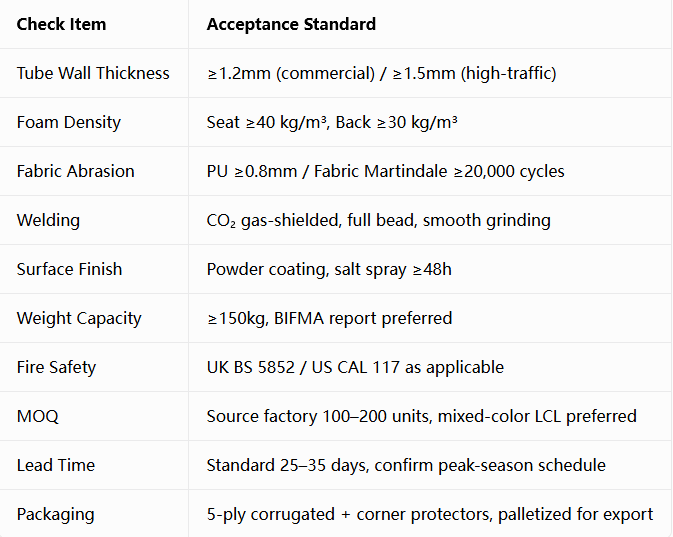
- Wall Thickness: Commercial dining requires a minimum wall thickness of 1.2mm; high-traffic venues (e.g., banquet halls) should specify 1.5mm+. Below 1.0mm, chairs deform under frequent adult use.
- Welding: Inspect welds for full penetration and smooth grinding. Quality factories use CO₂ gas-shielded welding with uniform beads; small shops rely on spot welding that fails at stress points.
- Surface Finish: Powder coating outperforms spray paint — it is scratch-resistant and does not chip. Request a salt spray test report; coastal or humid environments require at least 48 hours of neutral salt spray resistance.
Factory Audit Tip: Request actual photos of tube wall thickness and welding close-ups — never rely on renderings alone.
Factor 2: Upholstery Foam — Density Determines "No Sag After 3 Years"
80% of a dining chair's comfort and durability depends on the foam.
- High-Density Foam: Seat cushions should be 40–45 kg/m³, backrests 30–35 kg/m³. Foam below 35 kg/m³ shows visible sagging after 6 months of high-frequency use.
- Resilience: Quality foam rebounds quickly with no lasting indentation. Ask for a foam density test report.
- Cushion Structure: The premium approach is a "foam + spring unit" or "foam + elastic webbing" dual-layer structure, which outlasts pure foam. Some factories cut costs with shredded foam — it looks full but has a very short lifespan. Always ask.
- Fire Standards: For UK exports, BS 5852 is required; certain US states require CAL 117. Confirm target-market regulations before ordering.
Factor 3: Fabric Selection — Stain Resistance and Cleanability Define Commercial Suitability
Spills are inevitable in dining environments; the wrong fabric creates ongoing headaches.
- Leather (PU/PVC): The commercial first choice — oil-proof, waterproof, wipe-clean. Distinguish PU (softer, more breathable) from PVC (more durable but stiffer). Premium clients can choose microfiber leather with abrasion resistance exceeding 50,000 cycles.
- Fabric: Suitable for cafés and light-food venues with low grease. Choose stain-resistant treated fabric with a Martindale rating of at least 20,000 cycles.
- Fabric Thickness: PU leather should be 0.8mm+; thinner material tears easily from keys or cutlery.
- Color Fastness: Dark fabrics require color fastness testing to avoid dye transfer onto customers' clothing.
Factor 4: Structural Stability and Ergonomics
A good-looking but unstable chair is a safety liability in a restaurant.
- Weight Capacity: Commercial chairs should support at least 150kg. Request a BIFMA test report (American furniture standard).
- Leg Stability: Do adjustable or non-slip foot pads compensate for uneven floors? Quality chairs include adjustable glides or non-slip nylon pads.
- Seat Height and Depth: Standard table height is 75cm, matching a seat height of ~45cm. Seat depth of 40–42cm fits most body types; excessive depth compresses the back of the knees.
- Backrest Angle: A slight 5–10° recline is most comfortable; fully vertical backs cause fatigue during long meals.
- Stackable Design: For banquet halls and event venues, stackable design drastically reduces storage and shipping space, lowering logistics costs.
Factor 5: MOQ, Lead Time and Customization Capability
In wholesale procurement, supply chain stability matters as much as price.
- MOQ (Minimum Order Quantity): Source factories typically require 100–200 units per color per model; trading companies may accept 50 units but at higher unit prices. For trial orders, ask about mixed-color container consolidation.
- Lead Time: Standard models take 25–35 days; custom fabric or colors take 35–50 days. Peak season (Q3–Q4, Christmas stocking) adds 1–2 weeks — order early.
- Customization: Can the supplier change fabric, color, or add embroidered logos? Source factories usually handle this directly; traders add a secondary communication layer and longer lead times.
- Packaging: Export standard is 5-ply corrugated cartons with EPE corner protectors. Palletization is recommended for forklift handling. Confirm whether chairs ship fully assembled or flat-packed (KD). Flat-pack saves 30%–40% on ocean freight but requires on-site assembly.
Factor 6: Price Breakdown and Identifying the "Low-Price Trap"
A lower wholesale price is not always better — learn to decompose the cost structure.
A metal upholstered dining chair's ex-factory price roughly breaks down as: tubing (25%–30%) + foam & fabric (30%–35%) + labor (20%–25%) + packaging & logistics (10%–15%) + profit (5%–10%).
If a quote is 20%+ below competitors, it usually means:
- Reduced tube wall thickness (1.5mm → 1.0mm)
- Lower foam density (40 → 25 kg/m³)
- Recycled or shredded foam
- Simplified welding and grinding
- Reduced packaging, raising transit damage rates
Recommended Approach: Request samples from 3+ suppliers. Measure wall thickness, weigh the chair, and compare foam by compression. Sample fees are typically deductible against bulk orders.
Summary: Wholesale Metal Upholstered Dining Chair Checklist
About T&J FURNITURE
T&J FURNITURE (Xinkailong Furniture) is a metal upholstered dining chair source factory based in hebei, China. For nearly a decade, we have provided OEM/ODM custom services to European and American restaurant brands, hotel groups and furniture distributors. Our factory operates the full production chain in-house — tube cutting, welding, powder coating, sewing and upholstery. We support fabric customization, color matching and logo embroidery, with a standard MOQ of 100 units and mixed-color container consolidation available.